Tesla’s Shift to Proprietary Mapping Undermines Its Long-Stance on Camera-Only Autonomy
The company’s admission that it is building its own maps to address FSD shortcomings marks a direct contradiction of years of public messaging.
By Noor Haddad ·
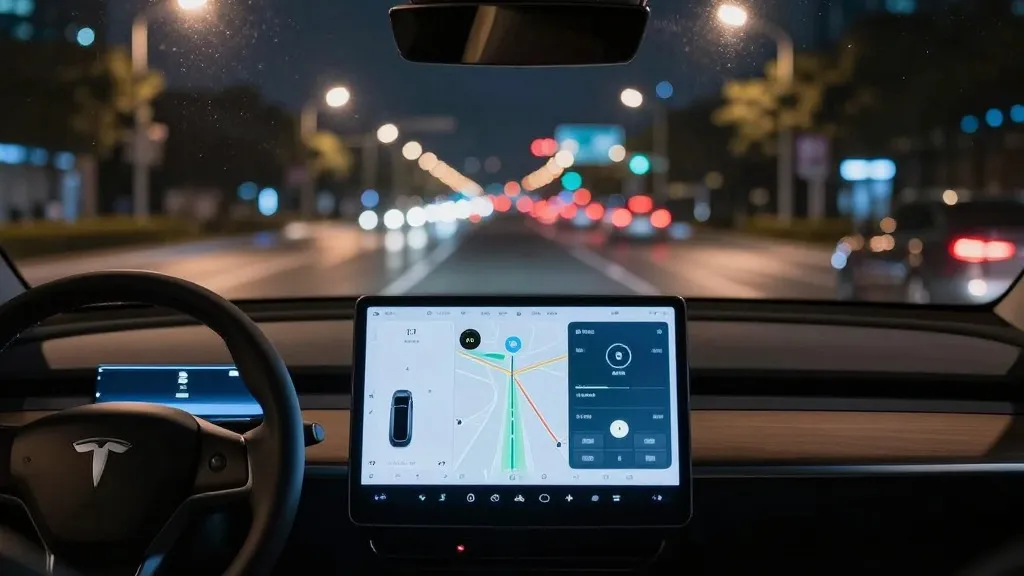
Tesla has announced it is developing a proprietary mapping system to rectify persistent deficiencies in its Full Self-Driving (FSD) software, specifically regarding speed limit recognition, parking, and route determination. The initiative was detailed by Ashok Elluswamy, Tesla’s Vice President of AI, during the company’s third-quarter 2026 earnings call. This strategic pivot represents a significant departure from the firm’s previous insistence that self-driving systems reliant on map data are inherently unstable.
The decision to construct an internal map layer stems directly from user feedback. During the shareholder Q&A session, a retail investor highlighted that mapping remains a critical obstacle for FSD, citing speed limits, parking, and route planning as the primary areas where the system struggles. Elluswamy acknowledged this feedback, conceding that the company “shouldn’t be depending on external people’s maps.” In response, Tesla is deploying a new AI-based mapping and navigation architecture that aggregates collective fleet data. This system will also incorporate individual driver preferences and voice commands, initially handling the start and end of trips in the upcoming FSD v15 update, with full navigation and parking capabilities to follow.
This development is particularly notable when viewed against Tesla’s historical stance on mapping technology. In 2015, the company began constructing high-precision maps with “100 times the level of granularity” of standard navigation tools. However, by the 2019 Autonomy Day presentation, Elon Musk had reversed course, characterizing high-precision lane maps as a “huge mistake” and a “really bad idea” that renders systems “extremely brittle.” This rhetoric aligned with the company’s commitment to a vision-only approach that eschews lidar and detailed cartography.
The necessity for a map layer highlights unresolved challenges regarding the vehicle’s ability to interpret its environment. While Tesla maintains it is not building the specific type of high-precision map Musk previously disparaged, the focus on speed limits and parking indicates that the vision system cannot consistently process this information. A road safety group in Brussels recently observed that FSD accelerated in 55% of 30 km/h zones tested, and the US National Highway Traffic Safety Administration (NHTSA) is currently considering an investigation into reports of Tesla vehicles speeding in active school zones.
Consequently, Tesla’s operational model is converging with that of its competitors. The company is now describing a process wherein its fleet collects environmental data to assist other vehicles in navigation, a method functionally similar to Waymo’s approach of mapping cities with sensor-equipped vehicles prior to service launch. This shift toward geofenced, map-dependent operations contradicts previous assertions that such restrictions do not constitute a “true self-driving system,” marking a decade into development a realization that maps are essential to reliable autonomy.
Source: Electrek